Chinese First Names Male and Meanings
Choosing a name is a significant moment in Chinese culture, often reflecting deep meanings tied to virtues, nature, family aspirations, or historical lineage. This guide explores Chinese first names male and meanings, helping you understand how these names have evolved from ancient traditions to modern trends. Whether you’re looking for powerful names, rare picks, or names starting with “X”, this article offers a comprehensive list categorized by type, along with meanings to inspire and inform.
Chinese male names are traditionally written with one or two characters — the family name comes first, and the given name (the first name) carries the meaning [6]. Parents choose those characters to voice wishes for the child’s future, drawing on ideals with Confucian, Taoist, and Buddhist roots [5]. Meaning-driven naming of this kind appears across many cultures — our guide to African American male names traces a parallel tradition of encoding heritage and aspiration into a child’s name — but Chinese naming is unusual in how directly the dictionary meaning of each character feeds into the choice [1][2].
In this article, you’ll discover:
- How Chinese name meanings actually work (the homophone principle)
- Ancient, traditional, and old Chinese male names with meanings
- Rare and typical picks, powerful names, and names beginning with X
- Featured picks: three names our editors would shortlist
- The most popular Chinese names for boys — with official 2020 data
- What U.S. name data actually shows (45 spellings checked against SSA)
- A quick pinyin pronunciation guide for English speakers
- Historic namesakes, from Confucius to Lu Xun
- Cultural considerations: naming taboos, the five elements, generation poems
- A complete sources and references list behind every claim
If you are also exploring names from other world cultures, you may want to read our guides on Armenian boy names and Colombian boy names.
How this guide is organized
Chinese naming sits where hard data meets cultural interpretation, so we keep the two visibly apart. Every section below carries a colored tag:
- Verified Datacharacter definitions, history, and U.S. name statistics, cross-checked against the numbered sources at the end of this guide.
- Editorial Ratingour team’s assessments and picks, clearly labeled as opinions — never as measurements.
- Cultural Discussiondescriptive commentary on customs and family practice; observations, not rules.
How Chinese Name Meanings Work
Before the lists, one principle changes how you should read every table on this page: Chinese names are written in characters, not letters. The romanized spelling you see here — pinyin, the standard system used in China since the 1950s [6] — is a pronunciation guide, nothing more. One spelling usually maps to many different characters with completely different meanings. Yichen, the most-used boys’ name of 2020 [3], is usually written 奕辰 (“splendid morning”), but 亦辰, 屹辰, and other pairings shift the meaning again.
The same is true of Shun: as 顺 it suggests smoothness and obedience, while 舜 is the legendary sage-emperor. Two entries in our tables can even belong to a single legend — Kun (鲲), the giant fish of the Daoist classic Zhuangzi, and Peng (鹏), the giant bird it transforms into [8]. Whenever a name matters to you, confirm the intended characters and their dictionary definitions [1][2] before committing: the table meanings are the start of the journey, not the destination.
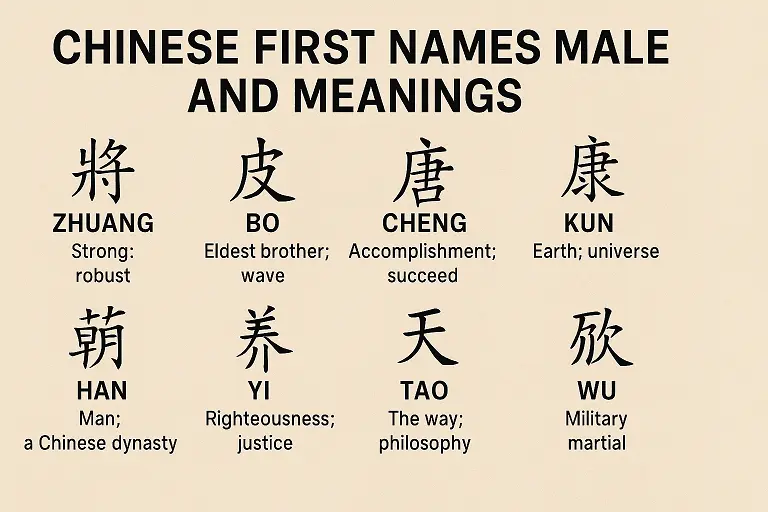
Ancient Chinese First Names Male
Ancient Chinese male names often date back to dynastic periods such as the Zhou, Han, and Tang dynasties, when scholars, warriors, emperors, and poets shaped the naming tradition. These names were typically chosen on philosophy, virtue, or status, and they express Confucian values such as loyalty, wisdom, righteousness, and filial piety — the same ideals the Analects and the classical canon taught for two thousand years [5][8]. Written in the same characters their first bearers used, they remain readable — and usable — today.
Historical Relevance of Ancient Names
Ancient names survive in classical texts and dynastic histories, from the Analects to the Records of the Grand Historian [8]. Reading them shows how directly the society of the time tied a name to personal character and social contribution — and explains why single characters like Yi (righteousness) and De (virtue) still anchor modern names.
| Name (Chinese & English) | Meaning | Listen |
|---|---|---|
| 壮Zhuangjwahng | Strong; robust | |
| 伯 / 波Bobwaw | Eldest brother; wave | |
| 成Chengchung | Accomplishment; succeed | |
| 良Lianglyahng | Good; fine; bright | |
| 义Yiyee | Righteousness; justice | |
| 坤 / 鲲Kunkwin | Earth; the great fish of Daoist legend | |
| 汉Hanhahn | Man; a Chinese dynasty | |
| 道 / 涛Taotow | The way; a wave | |
| 武Wuwoo | Military; martial | |
| 富 / 福Fufoo | Wealth; blessing | |
| 平Pingping | Peaceful | |
| 淑Shushoo | Gentle; kind-hearted | |
| 安Anahn | Peace | |
| 德Deduh | Virtue | |
| 仁Renrun | Benevolence |
Traditional Chinese First Names Male
Traditional names have been used consistently over centuries and are deeply rooted in Chinese customs and language. These names usually reflect the characteristics that families wish upon their children — health, success, respect, and happiness — passed down in the same characters generation after generation.
Components of Traditional Names
Most traditional names consist of two characters that, when combined, create a single wish. Jianjun, for example, joins jian (建, “to establish”) with jun (军, “army”) [1]; Guoliang joins guo (国, “nation”) with liang (良, “good”) [2]. The pairing is the parents’ composition — two dictionary words fused into one private sentence.
| Name (Chinese & English) | Meaning | Listen |
|---|---|---|
| 明浩Minghaoming-how | Bright and vast | |
| 建军Jianjunjyen-jwin | Establish the army | |
| 伟豪Weihaoway-how | Great and powerful | |
| 浩然Haoranhow-rahn | Vast and righteous | |
| 志远Zhiyuanjur-ywahn | Ambition and far-reaching | |
| 奕辰Yichenyee-chun | Splendid morning | |
| 春华Chunhuachwin-hwah | Spring blossom | |
| 慧良Huilianghway-lyahng | Intelligent and good | |
| 国良Guolianggwaw-lyahng | Good for the nation | |
| 天生Tianshengtyen-shung | Heaven-born | |
| 博源Boyuanbwaw-ywahn | Broad origin | |
| 德心Dexinduh-shin | Virtue and heart | |
| 世杰Shijieshur-jyeh | World and hero | |
| 天命Tianmingtyen-ming | Heavenly life/destiny | |
| 香君Xiangjunshyahng-jwin | Fragrant gentleman |
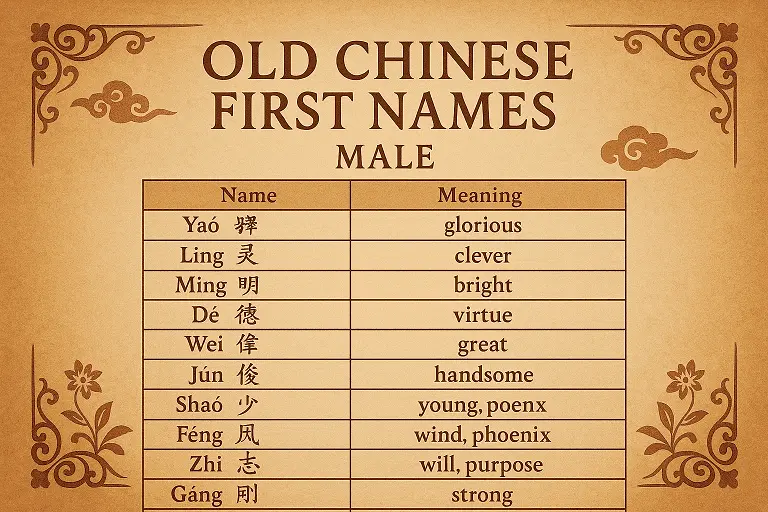
Old Chinese First Names Male
Old Chinese male names often consist of a single character and survive mainly in classical literature and historical accounts. They tend to be strong, straightforward, and foundational — bravery, wisdom, prosperity — delivered in one syllable.
Legacy and Simplicity
These names are commonly seen among scholars and rulers in ancient texts. Their simplicity and timelessness give them a distinguished appeal, and many now do double duty as the second character of a modern two-character name.
Peng in this table shares a legend with Kun, an entry in the ancient-names table: in the Daoist classic Zhuangzi, the giant fish Kun (鲲) transforms into the mighty bird Peng (鹏), whose wings stretch like clouds across the sky [8]. Two entries, one transformation story — a compact example of how much literature can hide inside a single syllable.
| Name (Chinese & English) | Meaning | Listen |
|---|---|---|
| 气Qichee | Energy; life force | |
| 鹏Pengpung | Giant bird of legend | |
| 剑 / 健Jianjyen | Sword; strong | |
| 彬Binbin | Refined; cultured | |
| 文Wenwun | Literature; cultured | |
| 瑞Ruirway | Auspicious; lucky | |
| 强Qiangchyahng | Strong | |
| 华Huahwah | Prosperous; magnificent | |
| 德Deduh | Virtue; morality | |
| 忠 / 中Zhongjawng | Loyalty; middle | |
| 宏 / 洪Honghawng | Grand; vast | |
| 迅Xunshwin | Swift; speedy | |
| 涛 / 桃Taotow | Wave; peach | |
| 雷Leilay | Thunder | |
| 山Shanshahn | Mountain |
Rare Chinese First Names Male
Rare Chinese male names are chosen to be distinctive and unique. They often draw from classical poetry, ancient philosophies, or are custom-created from meaningful characters — the poetic end of the naming pool.
Unique and Poetic
These names are ideal if you want a name that stands out with a poetic or artistic meaning. Two entries carry built-in stories: Yuheng (玉衡) is also the traditional name of a star in the Big Dipper’s handle, and in a classical tale the qin master Boya (伯牙) played for the one friend who truly understood his music — giving Chinese the term zhiyin, “the one who knows the tune.” Uncommon, elegant, and layered — that is the point.
| Name (Chinese & English) | Meaning | Listen |
|---|---|---|
| 莲玉Lianyulyen-yoo | Lotus jade | |
| 泽轩Zexuandzuh-shwen | Gracious and elegant | |
| 玉衡Yuhengyoo-hung | Jade balance; a star of the Big Dipper | |
| 康宁Kangningkahng-ning | Healthy and peaceful | |
| 金玉Jinyujin-yoo | Golden jade | |
| 书豪Shuhaoshoo-how | Scholarly and heroic | |
| 旭荣Xurongshew-rawng | Rising sun and glory | |
| 伯牙Boyabwaw-yah | The legendary qin master | |
| 涵哲Hanzhehahn-juh | Depth of water and wisdom | |
| 凤鸣Fengmingfung-ming | Phoenix song | |
| 思涵Sihansuh-hahn | Thoughtful and accommodating | |
| 瑞林Ruilinrway-lin | Auspicious forest | |
| 举人Jurenjew-run | Imperial-examination graduate | |
| 晨阳Chenyangchun-yahng | Morning sun | |
| 泽明Zemingdzuh-ming | Bright and clear |
Typical Chinese Male First Names
Typical names are those that appear commonly across different regions of China. They represent familiar values like intelligence, kindness, or strength and are suitable across generations. In China, “typical” also means era-typical: the single-character Wei, Lei, and Yong that filled 1970s and 1980s classrooms are the parents of today’s Zihans and Yichens [3].
Common Yet Meaningful
These names may seem common, but they remain popular because of their positive connotations and cultural resonance — the comfort-food tier of Chinese naming.
| Name (Chinese & English) | Meaning | Listen |
|---|---|---|
| 俊Junjwin | Handsome; talented | |
| 威 / 伟Weiway | Power; prestige | |
| 好Haohow | Good; fine | |
| 杰Jiejyeh | Heroic; outstanding | |
| 雷Leilay | Thunder | |
| 涛 / 桃Taotow | Wave; peach | |
| 勇Yongyawng | Brave | |
| 明Mingming | Bright | |
| 刚 / 钢Ganggahng | Strong; steel | |
| 彬Binbin | Refined; cultivated | |
| 良 / 亮Lianglyahng | Good; shining | |
| 硕Shuoshwaw | Great; substantial | |
| 汉Hanhahn | Man; a dynasty | |
| 玄 / 轩Xuanshwen | Mysterious; elegant | |
| 凯Kaikeye | Open; victory |

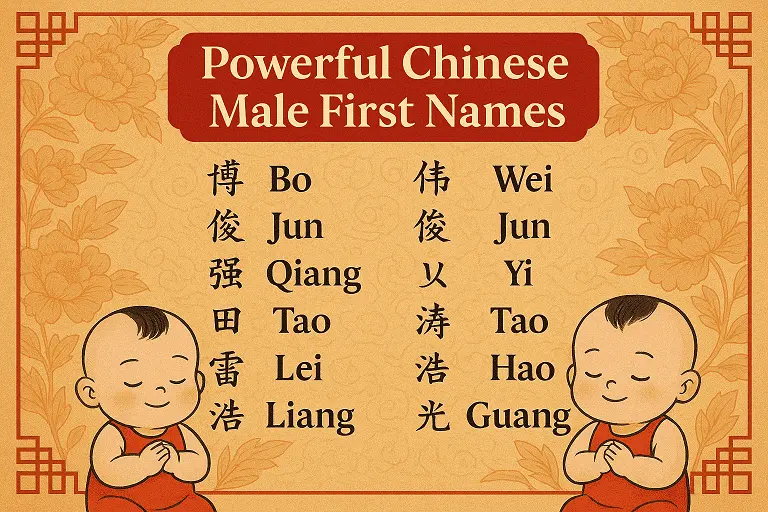
Powerful Chinese Male First Names
Powerful Chinese names often symbolize leadership, strength, and high moral character. These names are frequently selected by parents who wish their sons to grow into influential, respected individuals.
Names Signifying Strength and Leadership
Expect dragons, thunder, and heavenly elements — the classical power imagery of Chinese culture, from the dragon of the emperors to the thunder of the sky. Our editorial team includes these names for their imagery and sound; whether a name makes its bearer mighty is a matter for the bearer.
| Name (Chinese & English) | Meaning | Listen |
|---|---|---|
| 龙威Longweilawng-way | Dragon power | |
| 真玉Zhenyujun-yoo | True jade (symbol of virtue) | |
| 天雷Tianleityen-lay | Heavenly thunder | |
| 成龙Chenglongchung-lawng | Accomplished dragon | |
| 卫国Weiguoway-gwaw | Defend the country | |
| 雷浩Leihaolay-how | Thunder and greatness | |
| 玉龙Yulongyoo-lawng | Jade dragon | |
| 强胜Qiangshengchyahng-shung | Strong and victorious | |
| 天龙Tianlongtyen-lawng | Heavenly dragon | |
| 宝强Baoqiangbow-chyahng | Strong and precious | |
| 俊伟Junweijwin-way | Handsome and mighty | |
| 天硕Tianshuotyen-shwaw | Heavenly greatness | |
| 英杰Yingjieying-jyeh | Heroic; outstanding | |
| 召天Zhaotianjow-tyen | Summoned by heaven | |
| 国强Guoqianggwaw-chyahng | Strong nation — a classic mid-century name |
Chinese Male First Names Beginning with X
Names beginning with the pinyin letter X have a soft, airy sound in Mandarin that many parents love, and most are modern creations that retain a classical foundation — the X sound simply did not exist in older English transliterations such as Wade-Giles, so the spelling itself marks the modern, pinyin era [6].
Phonetic and Symbolic Harmony
In our editorial review, the letter X most often introduces characters whose meanings cluster around a handful of bright ideas — morning light (曦 xī), hope (希 xī), auspiciousness (祥 xiáng), fragrance (香 xiāng), and snow (雪 xuě)[1][2]. That is a pattern in the character pool, not a linguistic rule — plenty of X characters carry humbler meanings — but it helps explain why X-names read as gentle and luminous.
| Name (Chinese & English) | Meaning | Listen |
|---|---|---|
| 小龙Xiaolongshyaow-lawng | Little dragon | |
| 贤Xianshyen | Virtuous; noble | |
| 信怡Xinyishin-yee | Faithful and joyful | |
| 星宇Xingyushing-yoo | Star universe | |
| 雪峰Xuefengshweh-fung | Snowy peak | |
| 小波Xiaoboshyaow-bwaw | Little wave | |
| 祥 / 香Xiangshyahng | Fragrant; auspicious | |
| 曦晨Xichenshee-chun | Morning light | |
| 学俊Xuejunshweh-jwin | Learned and talented | |
| 小天Xiaotianshyaow-tyen | Little sky (symbol of freedom) | |
| 祥瑞Xiangruishyahng-rway | Auspicious omen | |
| 晓文Xiaowenshyaow-wun | Dawn light and culture | |
| 旭阳Xuyangshew-yahng | Sunlight of dawn | |
| 新海Xinhaishin-heye | New ocean | |
| 希哲Xizheshee-juh | Hopeful and wise |
List of unique Chinese Male Names
This comprehensive list includes a variety of Chinese male names with different meanings, drawn from both historical and modern inspirations. It provides a wide pool of choices for anyone interested in naming traditions.
Mixed Names for Versatility
These names mix classic, modern, and meaningful elements — ideal for baby names, character development, or cultural exploration. Haoyu (浩宇, “vast universe”) here completes the official 2020 top three [3].
| Name (Chinese & English) | Meaning | Listen |
|---|---|---|
| 良玉Liangyulyahng-yoo | Good jade | |
| 志成Zhichengjur-chung | Aspiration to succeed | |
| 凤 / 风Fengfung | Phoenix; wind | |
| 天宇Tianyutyen-yoo | Heavenly universe | |
| 博浩Bohaobwaw-how | Learned and vast | |
| 浩宇Haoyuhow-yoo | Vast universe | |
| 成玉Chengyuchung-yoo | Accomplished jade | |
| 国威Guoweigwaw-way | National prestige | |
| 林风Linfenglin-fung | Forest wind | |
| 宏涛Hongtaohawng-tow | Vast wave | |
| 志明Zhimingjur-ming | Ambitious and bright | |
| 文浩Wenhaowun-how | Cultured and vast | |
| 凯Kaikeye | Victory; open | |
| 顺Shunshwin | Obedient; smooth | |
| 宇豪Yuhaoyoo-how | Universe and heroic |
Featured Picks: Three Names Our Editors Would Shortlist
Long lists are where naming guides go to die, so before the deeper tables, here are the three names our team keeps coming back to — the official 2020 chart-topper, a two-thousand-year literary classic, and the one name on this page that American parents already use at scale. The ratings are ours; the data underneath comes with citations.
Featured Chinese Name — the 2020 chart-topper
Yichen
Splendid morning — 奕辰: 奕 “radiant” + 辰 “celestial time, morning”; the most-used given name for newborn boys in China in 2020 [3]
Our Editorial
Rating
9.2/10
Documented etymology
9/10 — both characters glossed in the standard dictionaries [1][2]; the pairing is exactly the modern poetic style the MPS reports track [3]
Rarity in the U.S.
10/10 — never once in the SSA boys’ top 1000, 1900–2025 [4] — about as distinctive as a chart-topping name can be in America
Pronunciation ease
8/10 — EE-chen — two clean syllables, none of the q/x/zh traps [6]
Team assessment, not a measurement — how we rate.
Featured Chinese Name — the literary classic
Haoran
Vast and righteous — 浩然, from the philosopher Mencius, who described the haoran zhi qi: a “flood-like” spirit of moral courage [5][8]
Our Editorial
Rating
9.0/10
Documented etymology
10/10 — one of the few names on this page with a named classical source — the Mencius itself [8]
Rarity in the U.S.
10/10 — never charted for American boys in any year on record [4]
Pronunciation ease
8/10 — how-RAHN — rhymes with “now” + “ron”; the r- takes a beat of practice [6]
Team assessment, not a measurement — how we rate.
Featured Chinese Name — the two-door crossover
Kai
Triumph — 凯, a single character with an unbroken dictionary pedigree [1][2], and the only pinyin name on this page that American parents already use at scale
Our Editorial
Rating
9.4/10
Rarity in the U.S.
6/10 — the opposite of rare: #93 in 2025 with 3,768 births, after peaking at #59 in 2022 [4]
Pronunciation ease
10/10 — one syllable in every language on Earth [6]
Team assessment, not a measurement — how we rate.
Popular Chinese Names Male
Some names are widely favored across Chinese-speaking regions due to their modern tone, elegant meanings, and cultural significance — and for once, popularity is a documented fact rather than a guess. In its 2020 national name report, China’s Ministry of Public Security reported that the three most-used given names for newborn boys were Yichen (奕辰), Yuxuan (宇轩), and Haoyu (浩宇) [3]. Two of the three — Yichen and Yuxuan — appear in the table below.
Top Picks in China and Abroad
These names combine contemporary appeal with classical elements, and they travel well: short, meaningful, and easy to romanize. Haoran (浩然) deserves a special note — it comes from the philosopher Mencius, who described the haoran zhi qi, a “flood-like” spirit of moral courage that fills a person who does right [5][8]; a two-thousand-year pedigree inside a current favorite.
| Name (Chinese & English) | Meaning | Listen |
|---|---|---|
| 奕辰Yichenyee-chun | Splendid morning | |
| 浩然Haoranhow-rahn | Vast and righteous | |
| 子涵Zihandzuh-hahn | Elegant and refined child | |
| 俊豪Junhaojwin-how | Handsome and heroic | |
| 明浩Minghaoming-how | Bright and vast | |
| 子轩Zixuandzuh-shwen | Intelligent and refined | |
| 宇轩Yuxuanyoo-shwen | Universe and elegant | |
| 晨皓Chenhaochun-how | Morning brilliance | |
| 嘉怡Jiayijyah-yee | Auspicious and joyful | |
| 子阳Ziyangdzuh-yahng | Sunny and refined | |
| 博源Boyuanbwaw-ywahn | Broad origin | |
| 雨泽Yuzeyoo-dzuh | Rain and kindness | |
| 天然Tianrantyen-rahn | Natural and pure | |
| 舒阳Shuyangshoo-yahng | Cheerful sun | |
| 泽林Zelindzuh-lin | Beneficial forest |
What U.S. Name Data Actually Shows
For American readers, one dataset answers the “how unique will it actually be?” question with real numbers: the Social Security Administration’s national baby-name statistics [4]. We checked 45 pinyin spellings from this guide against the SSA’s name-query tool on September 21, 2026 — boys, full history, 1900 through 2025. The result is the cleanest data cut of any naming culture we have covered: almost nothing charts.
Exactly four spellings have ever appeared in the boys’ top 1000. Two of them barely count: Long appeared in three years (best #821 in 1988) and Shan in two (best #898 in 1969) — blink-and-miss runs a generation apart [4]. That leaves Bo and Kai as the entire Chinese presence in American boy naming. Li — one of the most common surnames on Earth and a perfectly classical given-name syllable — has never charted for American boys in any year on record. Neither has Chen, Jun, Ming, Wei, Lei, Tao, Feng, Han, De, Ren, Yi, or thirty other spellings from our tables [4]. The virtue-and-poetry heart of Chinese naming is, statistically, invisible in America.
Bo carries a two-act American biography. It entered the top 1000 in 1977, jumped to #551 by 1981 — the Bo Derek era, a year after the film “10” — then slid almost all the way out by 2000 (#978) [4]. Since then it has been quietly climbing again, and 2025 — #449 with 698 births — was its best year ever [4]. A Chinese Bo (波 “wave” or 博 “learned”) reads perfectly in Mandarin; an American Bo reads folksy-Southern; both doors are open.
Kai is the star, and the only genuine two-door name on this page. It entered the top 1000 in 1979, reached the top 100 by 2019, peaked at #59 in 2022 with 5,374 births, and sat at #93 with 3,768 births in 2025 [4]. The Kai sound is spreading on its own — Kairo ranked #226 in 2025 [4]. The honest footnote: American Kai mostly arrived through its Hawaiian and Polynesian door, not the Chinese one (凯, “triumph”). For a bicultural family, that is the whole point — one spelling, two ancestries, both real.
One twist for the ledger: Kai also charted for girls — fourteen years, peaking at #770 in 2021 and out after 2023 — while Bo, An, and Shan never charted for girls at all [4]. The male side of Kai outweighs the female side by more than ten to one, so it reads decisively as a boys’ name that girls occasionally borrow. Parents of sons deserve to know which side of the ledger a name lands on before they fall in love with it.
How to Pronounce Chinese Names: A Quick Pinyin Guide
Every Chinese name on this page is one syllable per character: a two-character name like Zhiyuan is exactly two syllables (zhi + yuan), and a one-character name like Kai is one [6]. English speakers go wrong mostly on four consonants that pinyin spells in unfamiliar ways.
The four traps: pinyin q sounds like “ch” as in church (Qiang ≈ CHYAHNG); x sounds like a soft “sh” (Xiaolong ≈ SHYOW-LONG); zh sounds like “j” as in judge (Zhiyuan ≈ JEE-YWEN); and c sounds like “ts” as in tsunami (Cao ≈ TSAO) [6]. Everything else reads close to how it is spelled — Yichen is roughly EE-CHEN, Haoran HOW-RAHN.
Tones are real in Mandarin — kǎi with a dipping tone is a different utterance from kài falling — but they do not travel: no one expects an English speaker to produce tones, and the meaning of a written name does not depend on them [6]. Pronounce with confidence; the characters, not your tones, carry the name.
What Are Some Chinese Male Names?
If you’re wondering what are some notable or culturally significant Chinese male names, here are examples that span from ancient philosophers to modern writers. Each is documented in standard references such as the Encyclopaedia Britannica [5], and each has quietly shaped the name pool that parents draw from today.
Influential and Historic Names
These names come from history, literature, and philosophy — the people Chinese schoolchildren grow up reading. Notice how several of their characters (Shun, Wen, Bo) reappear in the tables above: classical figures remain the quiet source of modern name characters.
| Name (Chinese & English) | Meaning | Listen |
|---|---|---|
| 尧Yaoyow | Legendary sage-emperor of high antiquity | |
| 舜Shunshwin | Legendary sage-emperor, Yao’s chosen successor | |
| 孔丘Confucius (Kong Qiu)kawng-chyoh | Teacher and philosopher; the Analects record his sayings | |
| 老子Laozilow-dzuh | Founding figure of Daoism; traditional author of the Daodejing | |
| 孙武Sun Tzu (Sun Wu)swin-woo | Strategist; traditional author of The Art of War | |
| 庄周Zhuangzi (Zhuang Zhou)jwahng-joh | Daoist philosopher; source of the Kun–Peng story | |
| 秦始皇Qin Shi Huang (Ying Zheng)chin-shur-hwahng | First emperor of unified China (221 BCE) | |
| 司马迁Sima Qiansuh-mah-chyen | Han historian; author of the Records of the Grand Historian | |
| 李白Li Bailee-beye | Tang-dynasty poet, among China’s most celebrated | |
| 鲁迅Lu Xun (Zhou Shuren)loo-shwin | Pen name of Zhou Shuren; pioneer of modern Chinese literature | |
| 梁启超Liang Qichaolyahng-chee-chow | Late-Qing reformer, scholar, and journalist |
Cultural and Traditional Considerations
Names were never shared with elders. Traditionally, a child’s name avoided any character already used by a parent, grandparent, or honored ancestor — a respect convention that long predates modern China, and one historians trace across the dynastic record, where even the emperor’s personal characters were off-limits to his subjects [9]. The elder-name taboo is still the most widely observed custom on this list.
The five elements shaped many names. In traditional cosmology, a child’s birth moment could be read against the five elements — wood, fire, earth, metal, water — and when an element was believed to be weak, families compensated through the name, choosing characters with the matching radical (water-radical characters for a water deficit, and so on) [9]. The practice comes from Taoist-influenced folk tradition, not empirical science, and families who use it today generally treat it as heritage rather than instruction.
Generation poems fixed one character per generation. Many Chinese lineages kept a zibei — a short poem in which each successive character was assigned to one generation, so every cousin of a generation shared one character of his given name [9]. Read a genealogy and the family tree assembles itself from names alone. The custom survives mostly in family records today, but it explains why older Chinese names look so systematic.
Modern practice mixes all of these freely. A family today might check the grandparents’ names for taboo characters, half-remember the five elements, and then simply pick two characters that sound beautiful with the surname — tradition as seasoning, not recipe. The official decade reviews show the result: each generation’s names stamp its moment in history [3].
The Four Layers of Chinese Naming
Every Chinese Name Speaks From One of Four Layers
One name can stack layers — Jun (军, “army”) stamped the 1960s and still reads cleanly today, and Kai crosses the Pacific through its Hawaiian door while keeping 凯’s meaning. Pick the layer you want your son’s name to speak from, and the tables above give you the entries.
Conclusion
Understanding Chinese first names male and meanings offers a fascinating glimpse into a culture rich with symbolism, tradition, and modern flair. Seen together, the names in this guide read like generational time capsules — a pattern China’s official name reports make unusually visible: the 1950s chose Jianguo (“build the nation”), the 1960s Jun (“army”), the 1970s Yong (“brave”), the 1980s Lei (“rocks”), the 1990s Chao (“surpass”), and 2020 chose Yichen (“splendid morning”) [3]. Few naming cultures stamp their history into their children so legibly.
Whether you’re naming a child, creating a character, or simply exploring Chinese heritage, remember the one principle from the top of this guide: the letters are only the sound — the characters carry the meaning, so always confirm which characters a name uses. And a name’s story never ends at birth; it keeps evolving through nicknames and affection, as our collection of cute Spanish names to call your boyfriend shows with charm.
Sources & References
Sources & References
The Sources Behind Every Claim in This Guide
The linguistic, historical, demographic, and U.S. name-statistics claims in this article were checked against the following scholarly, government, and reference sources. Numbered citations [1]–[10] throughout the article point to this list.
-
Xinhua Zidian (新华字典), 12th edition (2020), Commercial Press
Standard character dictionary — definitions behind the name meanings
China’s standard single-volume character dictionary and one of the most-printed books on Earth. Used for the character definitions behind the name meanings throughout this guide — jian 建 “establish”, jun 军 “army”, kai 凯 “triumph”, chen 辰 “celestial time” — and for the character pool behind the X-name observations.
Print reference — check any major library or bookseller
-
MDBG CC-CEDICT Chinese–English Dictionary
Open online dictionary — character gloss cross-check
The standard open Chinese–English dictionary, maintained at mdbg.net. Every character gloss in this guide’s tables was cross-checked against CC-CEDICT during compilation.
https://www.mdbg.net/chinese/dictionary
-
Ministry of Public Security of the People’s Republic of China — National Name Reports (全国姓名报告), 2019 and 2020 editions
Government statistics — China name data
China’s official annual name reports, compiled from the national household registry. Used for: the three most-used given names for newborn boys in 2020 — Yichen 奕辰, Yuxuan 宇轩, Haoyu 浩宇 — and the reports’ review of leading names by birth era, from Jianguo in the 1950s to Chao in the 1990s.
www.mps.gov.cn (reports also republished by Chinese state media)
-
U.S. Social Security Administration — Popular Baby Names
Government statistics — U.S. name data
The official U.S. baby-name dataset, compiled from Social Security card applications. Every U.S. popularity and rarity claim in this guide was checked against the SSA name-query tool on September 21, 2026 — boys’ full 1900–2025 histories for 45 pinyin spellings from this guide (only Kai, Bo, Long, and Shan have ever charted), plus the girls’ histories for Kai, Bo, An, and Shan.
https://www.ssa.gov/oact/babynames/
-
Encyclopaedia Britannica — biographical and topic entries
Reference encyclopedia — historical figures and Confucian values
Used for the historical namesakes — Confucius, Mencius, Zhuangzi, Sun Tzu, Qin Shi Huang, Sima Qian, Li Bai, Lu Xun, and Liang Qichao — and for the Confucian-value framing of the ancient-names section.
https://www.britannica.com/
-
Norman, Jerry (1988). Chinese. Cambridge University Press
Academic print reference — Chinese linguistics
The standard one-volume linguistic reference on Chinese. Used for pinyin romanization, the one-syllable-per-character structure of names, homophony, and the pronunciation of the q/x/zh/c consonants.
Print reference — check any major university library catalogue
-
Ramsey, S. Robert (1987). The Languages of China. Princeton University Press
Academic print reference — language background
The standard survey of China’s language landscape. Used alongside Norman for the language background framing at the top of this guide.
Print reference — check any major university library catalogue
-
Chinese Text Project (ctext.org)
Online classical-text archive
A scholarly digital library of pre-modern Chinese texts. Used for the classical passages referenced here: the Mencius passage on the haoran zhi qi behind Haoran, and the Zhuangzi Kun–Peng transformation behind Kun and Peng.
https://ctext.org/
-
Wilkinson, Endymion S. (2018). Chinese History: A New Manual, 5th edition
Academic reference — naming customs
The standard researcher’s manual to Chinese history and its sources. Used for the naming-customs framing in the Cultural and Traditional Considerations section: elder-name taboos, five-elements naming practice, and generation poems (zibei).
Print reference — check any major university library catalogue
-
Behind the Name — Submitted Names: Chinese
Naming database — compilation aid
A long-running etymological name archive. Used to cross-check name lists and romanizations during compilation — not cited as an authority for any factual claim in this guide.
https://www.behindthename.com/submit/names/usage/chinese